Every household connected to the electricity network pays a standing charge regardless of how much electricity it uses.
From 1 October to 31 December 2026, the average electricity standing charge under Ofgem’s price cap is 54.83p per day for a household paying by Direct Debit. That is roughly £200 a year before a single kWh of electricity has been consumed.
But the term standing charge can give the impression that this is simply the price of maintaining a connection to the electricity network.
It isn’t.
The standing charge contains several completely different categories of expenditure, including network charges, supplier operating costs, policy costs, metering costs and allowances for supplier profit and risk.
At the same time, several of those same broad categories also appear within the price charged for each kWh of electricity.
That makes the true cost of accessing Britain’s electricity system unnecessarily difficult for consumers to understand.
What does the electricity standing charge pay for?
Ofgem published a particularly useful breakdown of the electricity standing charge as part of its review of standing charges.
For July–September 2024, the approximately £220 annual electricity standing charge was divided as follows:
| Cost | Annual amount | Share |
| Network costs | £121 | 55% |
| Supplier operating costs | £62 | 28% |
| Policy costs | £11 | 5% |
| Other costs | £26 | 12% |
| Total | £220 | 100% |
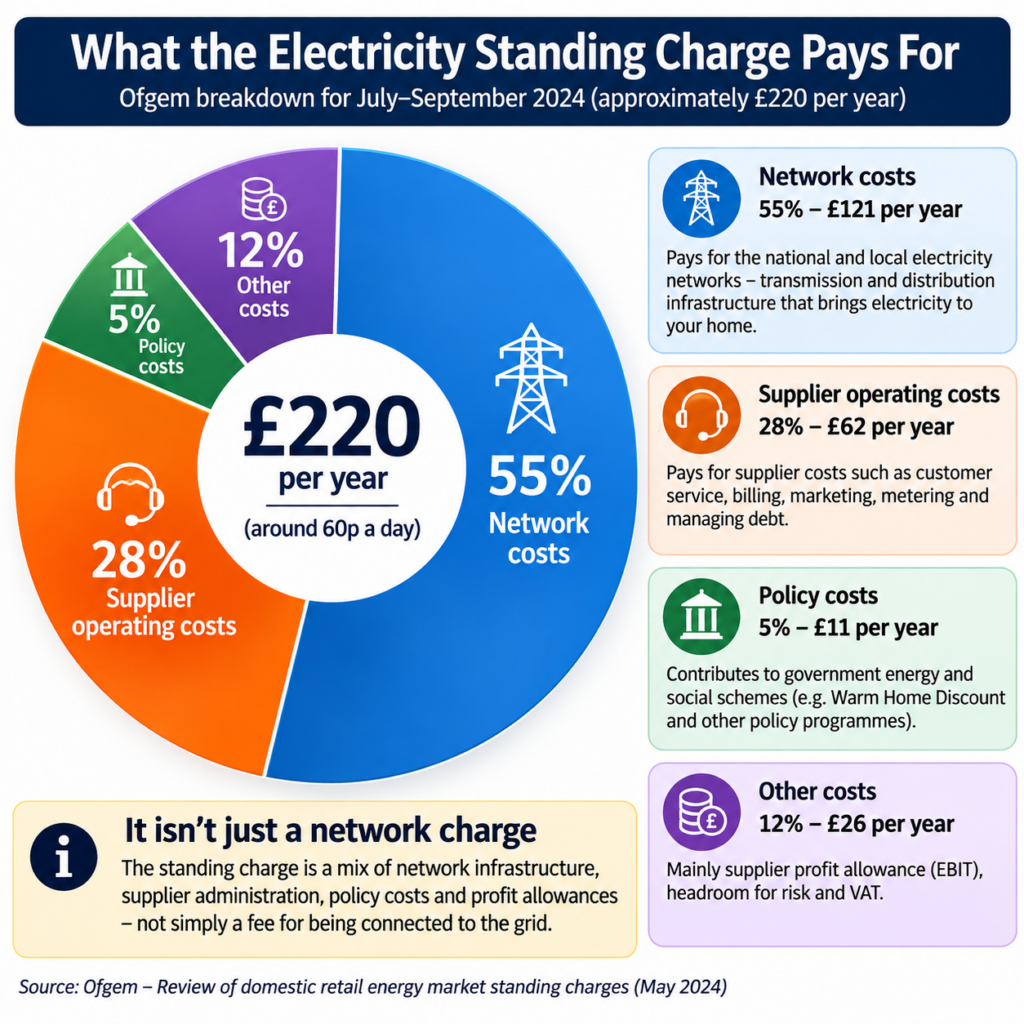
The precise values change between price-cap periods, so these figures should not be treated as the October 2026 breakdown. They are useful because they show what Ofgem itself considers to be inside the standing charge.
Network costs — around 55%
This is the largest component.
It contributes towards the electricity networks that move electricity from generators to consumers, including transmission and local distribution infrastructure.
This is the part of the standing charge most people would intuitively expect to be paying when they think of a charge for being connected to the grid.
Yet network costs are not exclusively recovered through the standing charge.
Network costs also form part of the allowances used to calculate electricity unit rates. Ofgem explicitly states that the costs making up the price cap are split between the unit rate and standing charge.
Supplier operating costs — around 28%
Almost three tenths of the 2024 electricity standing charge related to operating an energy supplier rather than operating the electricity network.
Ofgem describes supplier operating costs as including activities such as:
customer service, marketing, metering and managing debt.
That is worth highlighting.
A household paying a standing charge is not simply paying to keep wires connected to its property. It is also contributing towards the administrative cost of the company selling it electricity.
Policy costs — around 5%
Some government energy and social schemes have historically been recovered through the standing charge.
The way individual schemes are recovered changes over time, meaning the policy component of today’s charge will not necessarily resemble that of 2024.
This is another reason that treating the standing charge as simply a “network charge” is misleading.
Other costs — around 12%
Ofgem explained that its 2024 “other” category largely consisted of allowances applied across both standing charges and unit rates, including:
EBIT — the supplier profit allowance; headroom — an allowance for uncertainty and risk; and VAT.
From October 2026 electricity temporarily has zero VAT, so the current composition will differ.
Are consumers paying for the same thing twice?
Not literally.
Seeing “network costs” or “operating costs” in both the standing charge and unit rate does not mean suppliers are necessarily recovering the identical cost twice.
Ofgem allocates different portions of broad cost categories between the fixed and variable parts of the tariff.
But that distinction exposes the real problem.
A consumer cannot look at their bill and easily determine:
how much they paid for the electricity itself; how much they paid for the network; how much they paid for their supplier; or how much they paid towards government programmes and other system costs.
Instead, broad categories of expenditure can exist on both sides of the bill.
Ofgem itself says:
Costs within the price cap are split between the unit rate and the standing charge.
That may work as an accounting methodology.
It is not particularly transparent consumer pricing.
The postcode lottery
There is another problem.
The standing charge is not national.
Two identical households using exactly the same amount of electricity can pay substantially different fixed electricity charges simply because they live in different parts of Great Britain.
Ofgem says regional standing charges reflect factors including the number of consumers in an area, regional consumption and the costs of building and improving the network.
For October–December 2026 the regional differences are striking.
Using Ofgem’s electricity price-cap figures for the Direct Debit payment category, the annual fixed charge for a single-rate electricity meter is:
| Electricity region | Daily equivalent | Annual standing charge |
| London | 42.92p | £156.64 |
| North Western England | 45.68p | £166.72 |
| Southern England | 47.81p | £174.51 |
| East Midlands | 51.45p | £187.80 |
| Eastern England | 51.84p | £189.20 |
| South Eastern England | 52.32p | £190.96 |
| Northern Scotland | 55.14p | £201.25 |
| Southern Wales | 55.41p | £202.24 |
| South Western England | 55.58p | £202.87 |
| West Midlands | 57.23p | £208.89 |
| Southern Scotland | 61.41p | £224.14 |
| North Eastern England | 61.58p | £224.78 |
| Yorkshire | 61.67p | £225.09 |
| Merseyside & Northern Wales | 67.66p | £246.95 |
£90 a year simply because of where you live
The lowest figure is London at £156.64 a year.
The highest is Merseyside and Northern Wales at £246.95.
That is a difference of:
£90.31 every year.
The highest regional fixed charge is therefore about 58% higher than the lowest.
And this difference exists before either household consumes any electricity at all.
It raises a fundamental policy question:
Why should access to Britain’s national electricity system cost a household substantially more simply because of its postcode?
The regional difference is largely a network question
This becomes even more important once we remember that roughly half of the standing charge has historically related to networks.
Supplier customer service does not inherently cost 58% more because somebody lives in North Wales rather than London.
Nor should supplier billing systems.
Much of the rationale Ofgem gives for regional differences relates directly to the characteristics and cost of the regional electricity network.
That effectively means households in some areas are expected to carry a greater share of the cost of their local infrastructure.
Policy Seed takes a different view.
Electricity networks are national infrastructure.
A transmission line in Scotland carrying renewable electricity south benefits consumers elsewhere.
A distribution network supplying rural Wales forms part of the same electricity system as one supplying central London.
And as Britain electrifies transport and heating, strengthening those networks becomes national economic infrastructure rather than simply a local consumer expense.
A confusing mixture of fixed and variable charging
There is a broader issue with the existing system.
A consumer currently pays for electricity through two headline prices:
Standing charge + unit charge
But underneath them the separation is considerably less clear.
Network expenditure can influence both.
Supplier costs can influence both.
Profit and risk allowances can affect both.
Policy costs can be distributed between them.
And both rates can differ depending upon where the consumer lives.
The result is a system that may be understandable to energy-market accountants but is extremely difficult for ordinary consumers to interrogate.
Policy Seed proposal: replace it with a Network Access Charge
Policy Seed proposes replacing the existing electricity standing charge with a transparent National Network Access Charge.
Our proposed standard charge is:
£25 per month — £300 per year
Unlike today’s standing charge, its purpose would be explicit.
It pays for access to and maintenance, reinforcement and resilience of the electricity network.
And crucially:
The standard charge would be national.
A normal household in London would pay the same standard network subscription as one in Stoke-on-Trent, North Wales, Cornwall or Scotland.
The costs of maintaining Britain’s electricity infrastructure would be shared nationally rather than creating a postcode lottery.
That does not mean every property must always pay precisely the same amount. Policy Seed’s wider proposal allows different network-access tiers where there is a genuine reason — such as unusually high capacity requirements or three-phase connections.
But geography alone should not determine the price a normal household pays to access a national electricity system.
Make every part of the electricity bill explainable
Our wider tariff reform follows a simple principle:
Every charge should have a clearly identifiable purpose.
The electricity unit price should pay for electricity and the costs directly associated with delivering each additional unit.
The Network Access Charge should fund the infrastructure required to provide the connection.
Government welfare policy should be funded transparently through government.
Supplier margin should be explicitly regulated and visible.
Resilience funding should be identifiable.
Consumers should not require a collection of Ofgem spreadsheets to understand what they are paying for.
The standing charge isn’t just expensive. It is unnecessarily complicated.
The current system combines network infrastructure, supplier administration, policy expenditure, metering, profit allowances and risk allowances into a charge that varies dramatically depending on where somebody happens to live.
Then several of those broad cost categories appear elsewhere within the unit price as well.
Our proposed National Network Access Charge does something much simpler:
one national charge, for one identifiable purpose, funding one national electricity network.
Sources and further reading
Ofgem — Review of domestic retail energy market standing charges
Primary source for the breakdown of the electricity standing charge used on this page, including network costs, supplier operating costs, policy costs and other allowances.
Ofgem — Energy price cap: unit rates and standing charges
Current national and regional electricity unit rates and standing charges under the Default Tariff Cap.
Ofgem — October to December 2026 price-cap tables
Detailed regional price-cap figures used for the regional standing-charge comparison across Great Britain.
Ofgem — Energy price cap and standing charges explained
Ofgem’s explanation of what standing charges cover and how network costs, supplier operations and government schemes contribute to energy bills.
Ofgem — Default Tariff Cap levels and underlying models
Detailed methodology, allowance models and supporting data used by Ofgem to calculate the electricity price cap.
Data note: The standing-charge cost breakdown used on this page is based on Ofgem’s July–September 2024 analysis. The precise composition changes between price-cap periods. The regional standing-charge figures are from the October–December 2026 price cap, so the 2024 percentage breakdown should not be assumed to apply exactly to each 2026 regional charge.